 How-to
How Do New Bands Find Local Venues to Play?
Last Updated: November 1, 2026
Quick Summary
To find local venues for new bands, build a spreadsheet of rooms that book your genre at your draw level, then verify each one is active, genre-appropriate, and open to emerging acts before pitching. Ten verified venues beat a hundred unverified ones, so score each room and contact the talent buyer directly.
- Check a venue's calendar for show dates in the last 30 to 60 days to confirm it is active.
- Read the last 8 to 12 weeks of bookings to verify genre fit, not the venue's marketing.
- Score each venue 1 to 3 on genre fit, draw match, emerging-act openness, and accessibility.
- Prepare a live video, one-page EPK, honest draw number, and availability window before pitching.
- Follow up once after 7 to 10 days, then revisit the venue in three to six months.
Table of Contents
- Start With Venue Research for Independent Artists
- Find Local Venues That Book Original Music
- How to Contact Music Venues for a Gig
- Use a Band Booking Email Template That Gets Replies
- Check Venue Fit Before You Pitch
- Understand Show Terms, Draw, and Deal Basics
- Find Opportunities Beyond Venue Lists
- Plan Your First Round of Venue Pitches
- Frequently Asked Questions
Start With Venue Research for Independent Artists
Most new bands chase the biggest stage in town, get ignored, and conclude nobody books original music anymore. The truth is simpler: they skipped venue research.
Most guides hand you a list of famous clubs, useless to a band with no following. What you need is a repeatable method you can run every few months as your draw grows.
Build a Venue List That Fits Your Band
Start with a spreadsheet, not a wish list. Four columns do most of the work:
- Venue name and neighborhood
- Capacity and typical night
- Genre fit (what they actually book, not what they claim)
Fill it in from three sources: local music blogs and alt-weeklies; the show calendars of bands one step ahead of you, noting where they played six months ago; and other local bands directly, who share this information freely.
Then filter hard. Cross out any room that only books tribute acts, cover bands, or touring packages. Cross out rooms whose smallest night still expects a draw you cannot bring. What's left is your real target list.
Find Local Venues That Book Original Music
The venues that book original music are not always the ones with the biggest sign, they are the ones whose calendar proves it. A room running three original bills a week beats a larger club that gives original acts one slot a month. Here is how to verify a venue is active, genre-appropriate, open to emerging acts, and accepting submissions.
Step 1: Confirm the Venue Is Active
A venue that stopped hosting live music six months ago will not reply. Before adding any room to your list, verify it is currently running shows.
- Check the venue's website and social channels for a show calendar with dates in the last 30-60 days.
- Cross-reference with local music blogs, alt-weeklies, and event listing sites.
- Look for recent live-show photos or videos; a calendar with no recent posts is a warning sign.
Step 2: Verify Genre Fit From the Calendar, Not the Marketing
Venue websites often describe themselves broadly ("live music every night") while the calendar tells a narrower story. Read the last 8-12 weeks of bookings.
- Note the genres booked. Mostly cover bands, tribute acts, or DJ nights means the room is not a fit for original music.
- Look for repeat bookings of local and up-and-coming bands, a pipeline you can enter.
- Identify support slots on touring shows, which signal a system for breaking in new bands.
Step 3: Confirm the Venue Accepts Emerging Acts
Not every room that books original music books new bands. Some rely on established local draws and touring packages. Look for signals that emerging acts are welcome:
- Local openers on touring bills (the strongest signal).
- Showcases, battle-of-the-bands nights, or new-music nights.
- All-ages or early-evening bills mixing newer acts with established ones.
If none of these appear over a two-to-three-month window, deprioritize the venue. It may become a target later as your draw grows.
Step 4: Find the Current Submission Instructions
Submission policies change. A venue that accepted email pitches last year may now use a form, a booking agency, or a talent buyer who only responds to referrals. Check, in this order:
- The venue's website, look for a "Booking," "Contact," or "Submit" page.
- Social profiles, many post submission guidelines or pinned booking info.
- Show flyers and event pages, the promoter or talent buyer is often named there.
- Other local bands, ask who booked them and how they made contact.
Record the current method in your spreadsheet. If the venue uses a form, note the fields so you can prepare assets in advance. If it names a talent buyer or booking agency, record that name and any stated preferences.
Step 5: Score Each Venue Before You Pitch
A simple scoring system keeps you honest. For each venue, rate 1-3 on:
- Genre fit (how closely the calendar matches your sound)
- Draw match (whether the room's typical night is in line with the crowd you can bring)
- Emerging-act openness (how often new local acts appear)
Anything scoring below a 7 out of 12 goes to a "revisit later" tab. Your active pitch list should only contain rooms that score well on all four.
Small Rooms, DIY Spaces, and All-Ages Shows
Do not overlook the small stuff. This is where most bands actually start.
- Small venues and music clubs: 50 to 200 capacity rooms where the door split is modest but the audience is real.
- DIY and underground venues: house shows, art spaces, and borrowed rooms run by local promoters. These build your first crowd.
- All-ages shows: often the most enthusiastic audiences, and a great way to grow a young fanbase.
Treating DIY shows as beneath you is a mistake. They are where you learn to hold a room. A packed basement of forty people who know your songs is worth more than an empty club of two hundred.
How to Contact Music Venues for a Gig
Contact the talent buyer, not the bar's general inbox. Find that name on the venue's website, on show flyers, or by asking another band. If the venue uses a booking agency or a form, follow that channel exactly, going around it usually backfires.
Before you write a single email, get your booking-readiness assets in order. Bookers are busy, and a pitch that requires them to chase you for basics will be ignored.
Get Booking-Ready Before You Pitch
Prepare these five assets and keep them in one folder or link:
- A recent live video. One song, shot on a phone is fine, as long as the audio is clear and the room is visible.
- A short electronic press kit (EPK). One page: band name, genre, hometown, a three-to-five-sentence bio, a photo, links to music and socials, and a line on your typical draw.
- Audience information. Be specific: "We brought 40-60 people to our last two local shows" beats "we have a strong following."
Write a Short, Specific Pitch
Lead with the date or window you want, your genre, and one line on your draw. Attach nothing on the first contact beyond a link. Keep it under 150 words.
Watch out: sending a mass email with every recipient visible kills your chances instantly. Send individually, even if the body is similar.
Follow Up Once, Then Move On
Most replies come after a single polite follow-up, not the first email. Wait 7-10 days, then reply in the same thread with a one-line nudge: "Just following up on the below, happy to send more if useful." Do not send a third message. If there is no reply, mark the venue "no response" and revisit in three to six months as your draw grows.
Track Every Pitch
Keep a simple tracker with these columns: venue, contact name, date sent, follow-up date, reply, outcome, and next action. Review it weekly. The pattern of who replies and who does not will tell you more than any generic advice.
Use a Band Booking Email Template That Gets Replies
A band booking email template saves time without sounding generic. Fill in the brackets, keep the tone plain, and send it as a real person.
Subject: [Band name] for [venue], [genre], [month] availability
Hi [booker name],
I'm [your name] from [band name], a [genre] band from [town]. We'd love a slot at [venue] in [month].
What to Attach and What to Leave Out
Attach a link, not a folder. One live clip and one band page are enough for a first email. Leave out press kits, long bios, and full EP downloads. Bookers are busy and will ask for more if they are interested.
Check Venue Fit Before You Pitch
Fit decides whether you get a reply. Check three things before you hit send. Does the venue book your genre on a regular night?
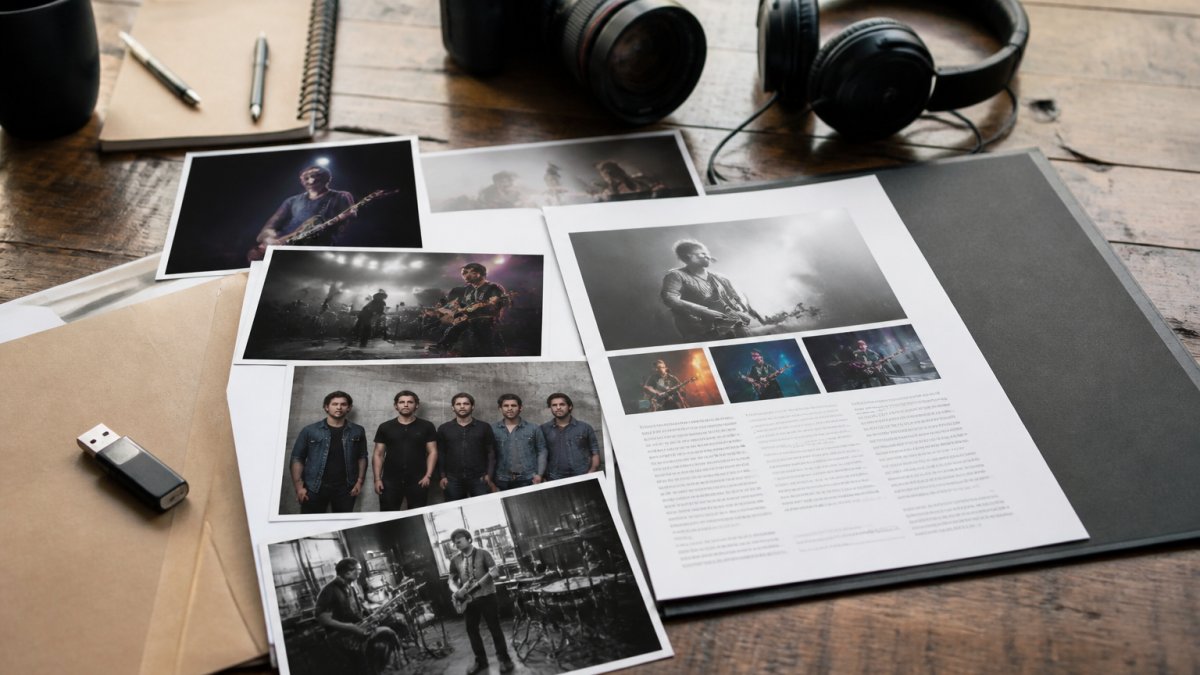
Seeing photography of a room can help you judge what the space and its scene look like before you pitch it.
Genre fit matters more than prestige. A punk band pitching a jazz club is wasting everyone's time.
Understand Show Terms, Draw, and Deal Basics
Know the deal before you agree to it. Most small-room bookings use one of a few models, and each carries different risk.
| Deal type | How it works | Best for |
|---|---|---|
| Door split | Band and venue share ticket or door money | Bands building a draw |
| Guarantee | Venue pays a fixed amount regardless of turnout | Established local acts |
| Guarantee vs. percentage | Band gets the higher of a fixed fee or a cut | Touring support slots |
| Flat buy-on | Band pays for a slot, keeps its own ticket sales | Acts with a strong fanbase |
Ask three questions before you accept any booking:
- Is there a guarantee, and how much?
- How is the door split calculated, and after which costs?
- What is the load-in time, set length, and backline situation?
Draw is the number of people who come specifically for you. Be honest about it. Overstating your draw gets you one show and no second one.
Find Opportunities Beyond Venue Lists
Venue lists run out fast. Local promoters who run nights across several rooms are gold, because one good relationship can lead to repeat bookings. Showcases and industry events put you in front of people who book multiple venues, and support slots on touring shows get you in front of new audiences. For industry-side news on how promoters, labels and venues discover and book emerging artists, read Notes from the pit.
Plan Your First Round of Venue Pitches
Turn research into a plan. Pick ten venues from your list that genuinely fit, ranked by fit, not fame. Send five emails this week and five next week, so you can track what works.
Before you send anything, get your press materials right. Follow a step-by-step guide to preparing for a band photoshoot so your photos are ready for your pitch materials. Professional band photos can strengthen the press kit you send to venues.
Keep a simple tracker: venue, date sent, reply, outcome. Follow up once after ten days, then move on. Once gigs are booked, you can book James DeSalvo Photography to cover the show.
Frequently Asked Questions
How can a new band find local venues to play?
Start by searching local music calendars, venue social accounts, and show listings for bills that match your genre. Note every room that books original music, then check each one's capacity, stage setup, and booking contact. Follow the bands you share a bill with, since their pages often reveal smaller venues and promoters. Keep a running spreadsheet with contact names, submission rules, and response dates so your venue research stays organized and repeatable.
How should a new band contact a venue about playing?
Send a short, specific email to the talent buyer or booking contact named on the venue's site. Introduce the band, name your genre, link one live video and one streaming page, and propose a realistic date window. Mention any local draw or bands you could bring. Avoid mass emails and long bios. One clear ask, a few links, and a follow-up after a week or two is the standard approach for how to contact music venues for a gig.
What should a band include in a booking email template?
A booking email template should include a subject line with the band name and genre, a two-sentence introduction, links to live video and streaming, a proposed date range, and a note on local audience or support acts. Keep it under 150 words and attach nothing heavy. Personalize the venue name and reference a recent show there. End with one clear question about availability so the booker can reply quickly.
How far in advance should a new band contact venues?
Contact smaller rooms four to eight weeks ahead and larger or more competitive venues two to three months ahead. Local venues that book original music often plan bills a month or two out, so early pitches get better slots. If a venue declines, ask about a future window and note it in your tracker. Consistent, well-timed follow-ups build the relationships that turn into repeat bookings and support slots.
Building a live schedule from scratch is slow work, and the first round of pitches rarely lands every room. We photograph musicians, bands, and the venues they play, so we see what makes a press kit stand out to a booker. Our music industry photography covers live shows, promo shoots, and editorial work for bands and labels. Get started with James DeSalvo Photography and give your next pitch the visuals that get replies.