 how-to
What to Wear for Outdoor Corporate Headshots
Table of Contents
- How Outdoor Light Changes What You Should Wear for Corporate Headshots
- Best Colors for Headshots in Natural Light
- Corporate Headshot Outfit Ideas for Men and Women
- What Not to Wear for Headshots Outdoors
- What to Wear for Team Headshots: A Coordinated Wardrobe Plan
- Fabric, Weather, and Location: Dressing for Outdoor Conditions
- Accessories, Grooming, and Final Preparation Checklist
- Conclusion: Dress for the Light, Not Just the Dress Code
- Frequently Asked Questions
Last Updated: October 14, 2026
How Outdoor Light Changes What You Should Wear for Corporate Headshots
Outdoor corporate headshots live or die on how your clothing handles natural light. Soft, diffused light flatters almost everyone; harsh midday sun casts hard shadows and blows out pale fabric.
Your outfit is a light-management tool. So what should you actually wear for outdoor headshots? Start with fabric and color, not brand names.
- Matte fabrics soak up light and photograph richer than shiny ones
- Mid-tone colors hold detail in both bright sun and deep shade
- Structured layers give the camera a clean line to work with
Below: colors, cuts, and a full team plan.
Best Colors for Headshots in Natural Light
The best colors for headshots in natural light are mid-tone, muted shades that separate you from the background without competing with it. Navy, charcoal, burgundy, and emerald green top the list.
Light blue works for a softer look and pairs cleanly with green foliage and stone backdrops. Avoid pure white and jet black outdoors: white blows out in direct sun, and black turns into a flat blob in shade.
How Outfit Colors Work With Outdoor Backgrounds
Your background is the variable indoor studios never have, a brick wall, green hedge, or gray building each shifts how your outfit reads.
- Green foliage: navy, burgundy, and cream stand out; skip olive and forest green
- Warm brick or stone: charcoal and light blue create contrast; avoid rust and orange
- Gray concrete or glass: emerald green and burgundy add life; skip all-gray outfits
The rule is simple. Pick a color that contrasts with the backdrop, not one that blends into it.
Corporate Headshot Outfit Ideas for Men and Women
Most guides stop at "wear a blazer." Outdoors, the same blazer reads as polished or as a wrinkled, wind-whipped mess depending on cut, fabric weight, and light. The pieces below are chosen for sun, shade, and breeze, not the mirror.
The universal rule: build from the face outward
Your face is the subject; every layer should frame it or get out of the way. Outdoors, prioritize:
- A defined shoulder line so wind and slouch don't blur your silhouette
- A neckline that stays put when you turn toward the light
- A mid-tone base layer that holds detail in both bright sun and open shade
For men: structured, matte, mid-tone
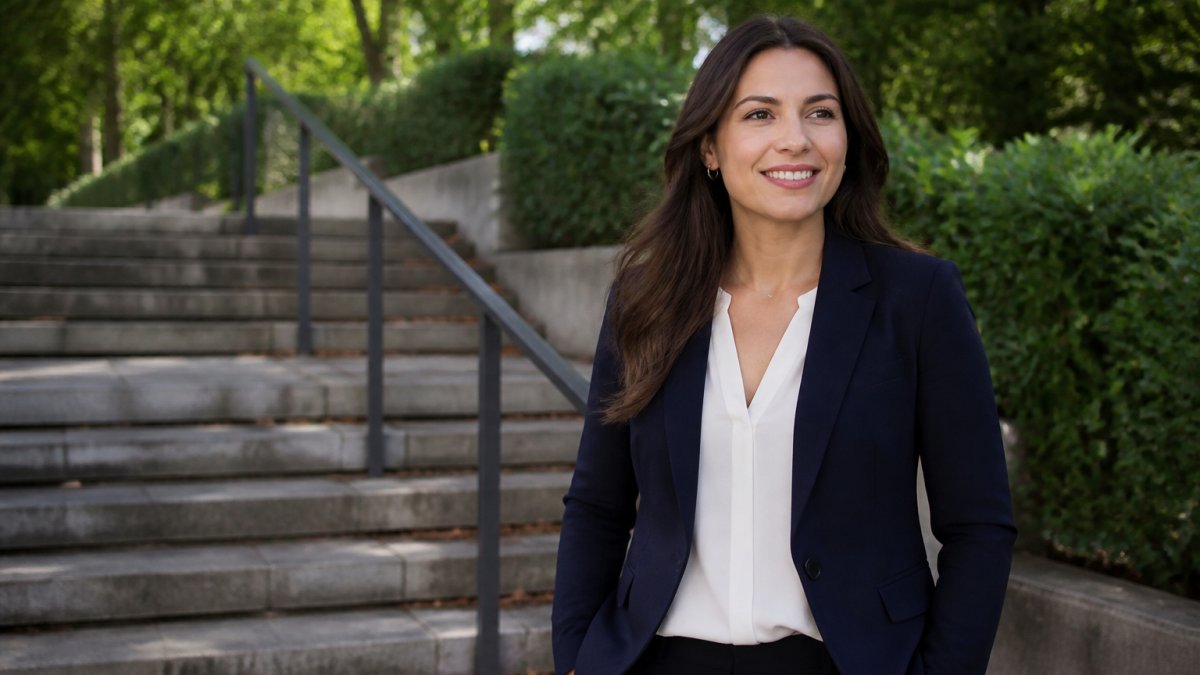
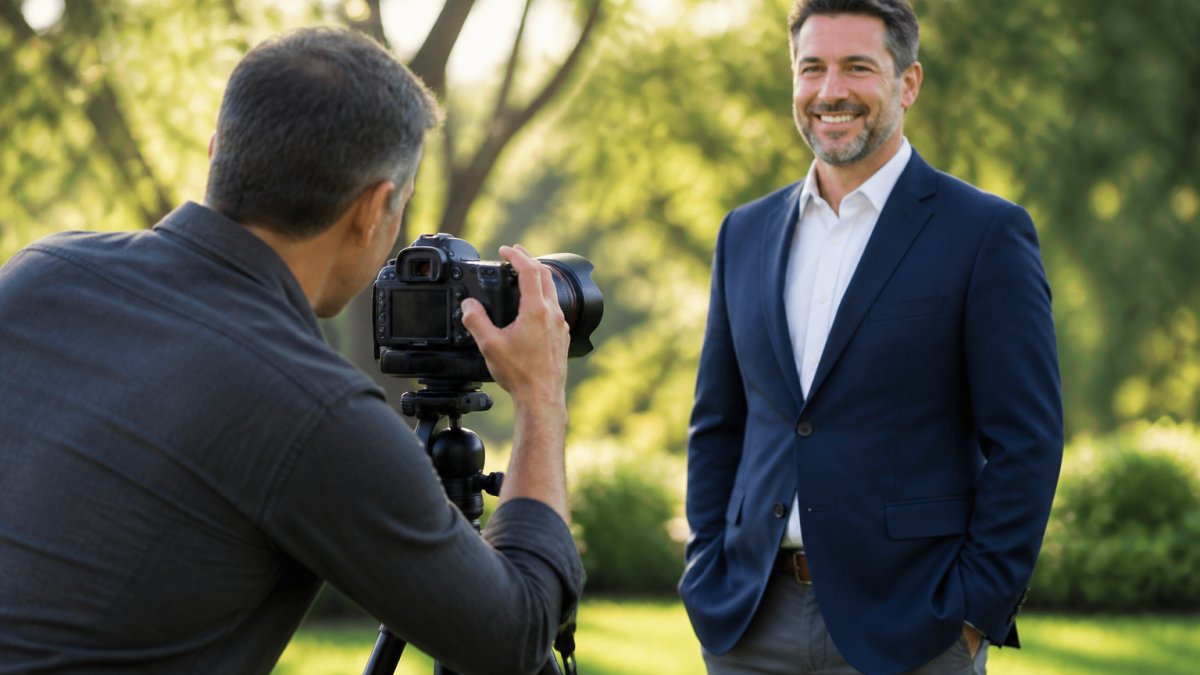
A navy or charcoal blazer over a light blue or cream shirt remains the strongest outdoor combination. The dark jacket anchors the frame; the lighter shirt lifts the face. Key adjustments:
- Fabric weight: a mid-weight wool or wool-blend jacket holds its shape in wind and resists creasing in humidity far better than lightweight cotton or linen.
- Shoulder fit: the seam should sit at the edge of your shoulder. Oversized shoulders catch light and read as a soft, undefined line.
- Shirt collar: a semi-spread or button-down collar stays crisp in breeze; a floppy collar curls and casts odd shadows on the neck.
For women: structure without stiffness
A fitted blazer or structured jacket in a solid mid-tone does the same work for women as for men: defines the shoulder, frames the face, resists wind. Practical notes:
- Blazer: a wool-blend or ponte jacket holds shape. A soft, unstructured cardigan drapes and can look rumpled in a still frame.
- Blouse: a simple shell in a matte fabric (crepe, matte silk, or a quality cotton blend) avoids the shine satin and silk throw back at the camera.
- Neckline: a V-neck or clean crew neck lengthens the neck and draws the eye up. A high, tight neckline can bunch under the chin when you tilt toward light.
Inclusive and role-specific adjustments
Outdoor corporate headshots serve a wide range of people, bodies, and workplaces. Adaptable principles:
- Body type: the goal is a clean vertical line. A tailored jacket, wrap top, or well-fitted dress all create that line. Avoid clothing that pulls across the chest or bunches at the waist, the camera exaggerates both.
- Gender expression: the framework is structure, mid-tone color, and matte fabric. A suit, a blazer over a blouse, a structured jumpsuit, or a tailored shirt all fit. Choose the silhouette that feels like you at your most professional.
- Cultural dress: if your professional identity includes a hijab, kufi, turban, or other cultural garment, treat it as part of the outfit's color and texture plan. Choose tones that contrast with the background and fabrics that hold shape in wind.
The outdoor test
Before the session, step outside in your chosen outfit. Turn toward the sun, then into shade. Have someone photograph you with a phone. Look for shine, transparency, wrinkles, and whether the neckline stays put. That two-minute test catches more problems than any style rule.
What Not to Wear for Headshots Outdoors
What not to wear for headshots outdoors comes down to anything that distracts, wrinkles, or fights the light. Busy patterns, logos, and shiny fabric are the biggest offenders.
- Large or loud patterns: they pull focus from your face
- Small tight patterns: they can shimmer or moiré on camera
- Logos and slogans: distracting and often off-message
What to Wear for Team Headshots: A Coordinated Wardrobe Plan
What to wear for team headshots needs one extra layer of planning: coordination. A team that looks unified without looking identical photographs far better than a mismatched group.
The goal is a shared color palette, not matching uniforms.
| Element | Do This | Avoid This |
|---|---|---|
| Color palette | Pick 2-3 shared tones | Everyone in the same shade |
| Jackets | Same level of formality | Mixed casual and formal |
| Shirts | Solid, mid-tone base | Competing patterns |
| Accessories | Minimal and consistent | Statement pieces that clash |
| Fit | Tailored for each person | One style forced on all |
Send the palette to the whole team a week ahead. Ask each person to bring two options. This one step prevents the most common team-shoot headache.
Fabric, Weather, and Location: Dressing for Outdoor Conditions
Indoors, fabric is almost irrelevant, the studio controls light, temperature, and air. Outdoors, fabric becomes a variable you manage. Here is how each condition changes what you wear.
How weather changes fabric behavior
- Direct sun: light-colored, shiny, or thin fabrics blow out and lose texture. Matte, mid-tone fabrics hold detail. Dark fabrics absorb heat and can show sweat.
- Open shade: the most forgiving light. Almost any matte fabric works, but very dark fabrics can go flat against a dark background.
- Overcast: soft, even light flatters most fabrics. The risk here is wind, not light.
Fabric-by-fabric outdoor guide
| Fabric | Outdoor strength | Outdoor weakness | Best for |
|---|---|---|---|
| Cotton | Breathable, matte, photographs rich | Wrinkles in humidity, can look flat | Shirts, blouses in mild weather |
| Wool blend | Holds shape, resists creasing, matte | Can be warm in summer | Blazers, suits, structured jackets |
| Linen | Cool in heat, natural texture | Creases heavily, can look rumpled on camera | Casual outdoor sessions only |
| Silk / satin | Luxurious drape | Shiny, reflects harsh light, shows sweat | Avoid for outdoor headshots |
| Fine-gauge knit | Smooth, matte, layers well | Can cling; shows every line underneath | Sweaters, layering pieces |
| Synthetic blends | Wrinkle-resistant, holds color | Can look shiny or cheap under sun | Travel-friendly backup options |
How location changes the choice
- Park or garden: greenery reflects a subtle green cast onto skin and light fabrics. Mid-tone navy, burgundy, cream, and charcoal stay true. Skip olive, forest green, and pale yellow.
- Urban street or brick: warm brick and concrete bounce warm light. Charcoal, navy, and light blue create clean contrast. Avoid rust, orange, and warm browns that blend into the wall.
- Rooftop or open sky: sky light is cool and blue. Warm mid-tones (burgundy, cream, camel) balance it. All-white outfits blow out against bright sky.
The backup plan
Outdoor sessions are unpredictable. A practical backup kit solves most weather surprises:
- One mid-tone backup shirt or blouse
- A structured jacket even if you plan to shoot without one
- A lint roller and a travel steamer or wrinkle-release spray
Accessories, Grooming, and Final Preparation Checklist
Accessories and grooming should support the shot, not steal it. Simple jewelry and clean grooming keep attention on your face.
Keep accessories minimal:
- Small studs or simple earrings
- One thin necklace at most
- A watch is fine, a stack of bracelets is not
- Skip sunglasses, even on a bright day
For grooming, tidy hair, neat facial hair, and a matte finish beat anything shiny. Bring blotting papers if you tend to shine.
Use this checklist the night before:
- Outfit pressed and hung, not folded
- Two color options packed
- Backup shirt in a mid-tone
- Simple jewelry chosen
Conclusion: Dress for the Light, Not Just the Dress Code
Dressing for outdoor headshots means thinking about light, background, and weather as much as style. Mid-tone colors, structured layers, and matte fabrics do the heavy lifting. Skip the white shirt, the loud pattern, and the shiny fabric.
At James DeSalvo Photography, we help clients plan every detail before the shutter clicks.
Please contact the business directly for specific service offerings and availability.
Frequently Asked Questions
What colors look best for outdoor corporate headshots?
Solid mid-tone and jewel tones photograph best outdoors: navy, charcoal, burgundy, emerald green, and light blue. These colors create flattering contrast against most outdoor backgrounds without competing with skin tones. Avoid neon brights and pure white, which can blow out in direct sun. If your session is in a green space, skip olive and forest green so you do not blend into the foliage.
What should I avoid wearing for a professional headshot?
Skip busy patterns, logos, graphic tees, and large prints, which distract from your face. Avoid sleeveless tops and deep V-necks if you want a traditional professional look. Neon colors, pure white, and all-black outfits can cause exposure problems in natural light. Wrinkled or ill-fitting clothing also shows in high-resolution images, so press and try on your outfit before the session.
Should I wear a jacket for an outdoor corporate headshot?
A structured blazer or jacket adds polish and creates clean shoulder lines that photograph well from any angle. For a formal look, a dark suit jacket in navy or charcoal works in almost any outdoor setting. For a more casual approach, an unstructured blazer over a collared shirt or simple blouse keeps the look professional without feeling stiff. If the weather is hot, choose a lightweight fabric like linen or a cotton blend.
How should I dress for a corporate headshot in warm weather?
Choose breathable fabrics like cotton, linen, or lightweight wool blends in mid-tone colors. A short-sleeve collared shirt or a sleeveless blouse under a light blazer works well. Bring blotting papers and a small towel to manage shine and perspiration. Schedule the session for early morning or late afternoon when temperatures are lower and light is softer. Avoid heavy dark fabrics that trap heat and show sweat marks.